

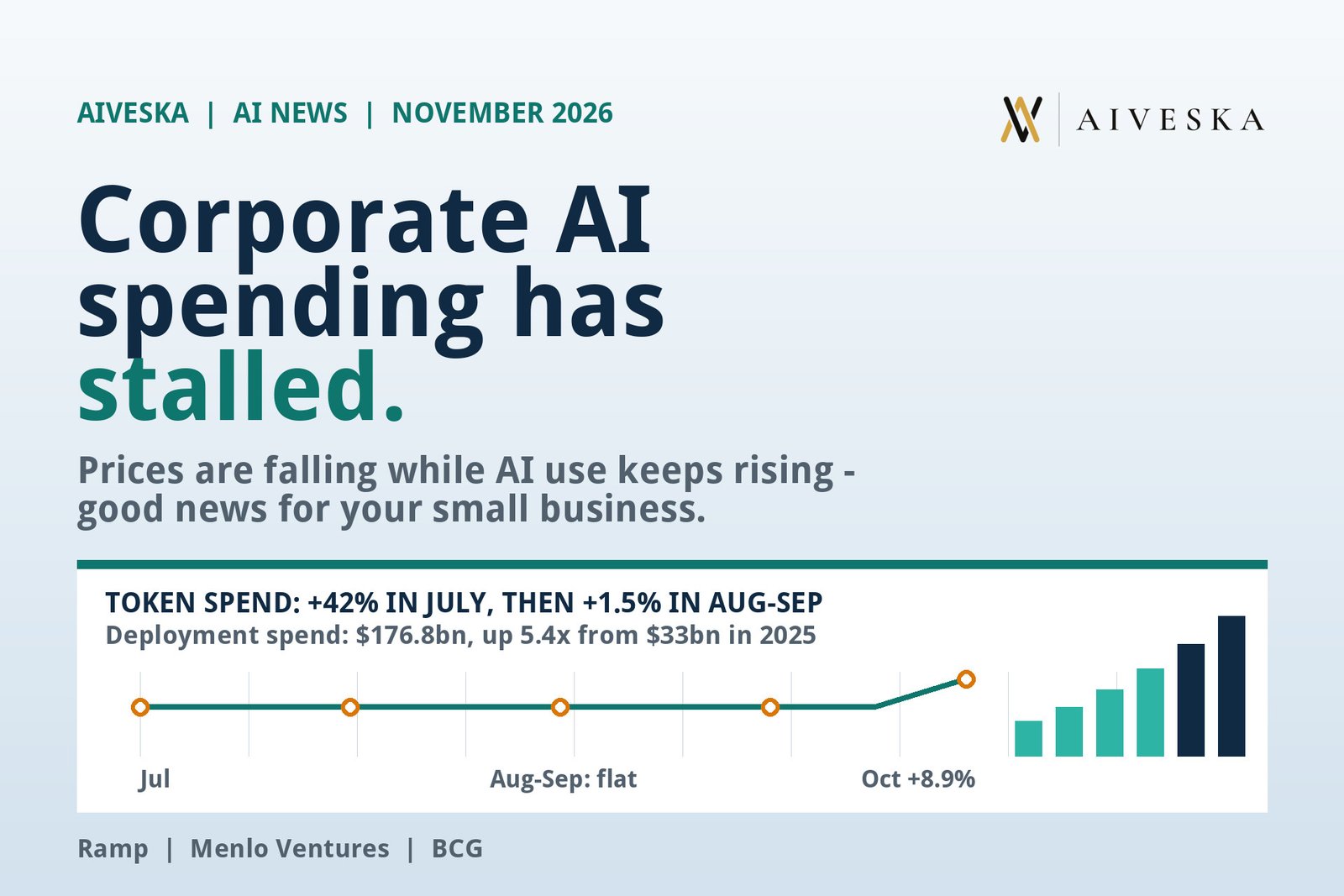
Companies are using more AI than ever — and paying barely a cent more for it. Corporate AI spending flatlined across August and September 2026, growing just 1.5% in two months combined, even as the volume of AI work kept climbing. That gap is the most useful business news of the month, because it means one thing for a small business owner: the vendors are fighting over you, and the price of AI is falling while the tools get better.
Bottom line up front: this is a buyer’s market, and corporate AI spending data proves it. OpenAI has halved some API prices, Anthropic has cut model prices so far it cost itself about $600 million in revenue growth, and enterprise discounts are everywhere. If you have been waiting for the right moment to put AI into a real workflow — answering customer emails, drafting quotes, keeping the books tidy — the market just handed you cheaper tools and a reason to lock prices in before the discounts end.
Table of Contents
Two numbers that look like they disagree
| What it measures | What happened | What it means |
|---|---|---|
| Token spend (Ramp, corporate cards) | Up 42% in July, then up just 1.5% across August and September | The metered price of using AI stopped growing |
| Deployment spend (Menlo Ventures) | $176.8 billion by September 2026, up 5.4x from $33 billion in 2025 | Total money going into running AI exploded |
Both numbers are true. They measure different things, and the difference is the whole story: the price of each unit of AI fell, while the amount of AI being used — and bought — rose sharply. For a small business, that combination is the best possible news. The rest of this article unpacks the numbers, explains why the flatline happened, and turns it into five practical moves.
What corporate AI spending actually looks like in 2026
The flatline comes from Ramp, the corporate card and spend-management company, which tracks what its customers actually pay for AI tokens — the metered units that language models charge for processing prompts and generating answers. Its numbers, reported by TechCrunch on 6 November 2026, are stark. Token spend grew 42% in July compared with June. Then, across August and September combined, it grew just 1.5%. October brought a partial recovery, with spend up 8.9% from 23 September to 23 October — but Ramp’s lead economist Ara Kharazian says the headwinds on growth are strong, and “the era of hypergrowth may be over.”
The averages hide a wide gap. The median company on Ramp’s platform spends just $12 to $15 per employee per month on AI tokens. The top 10% spend $600 to $1,000 per employee per month. And the top 1% — the most AI-heavy firms — spent $9,568 per employee in September, down 3.1% from their July peak of $9,873, slipping just below the $10,000 mark they had been hitting all summer. Kharazian’s point is blunt: the slowdown among that top 1% alone is “sufficient to slow down revenue entirely, despite the fact that we’re seeing rising volumes.”
Two things about that data matter for a small business reader. First, 55.9% of the businesses on Ramp’s platform paid for AI services in September, with Anthropic reaching 43.8% of them and OpenAI 40.6% — so AI spending is now normal, not exotic. Second, and more important, Kharazian is open that “almost the entire spend on AI is from venture-backed, high-growth tech companies.” The median small business does not have a $600-per-employee API bill. Your AI bill is probably a $20 ChatGPT Plus subscription, or $20 for Claude Pro, or a free tier. The corporate AI spending slowdown is a story about the biggest buyers — but its consequence, cheaper AI for everyone, lands squarely on you.
Why the flatline happened: a price war, not a demand problem
The slowdown is not because companies stopped wanting AI. Usage kept rising. The slowdown happened because the price of using AI fell, and because companies got smarter about what they pay for. Kharazian’s summary is short: “OpenAI and Anthropic price cuts have… just made it cheaper to use AI.”
The cuts are real and documented. In September, OpenAI halved API prices for two of its GPT-6 models, GPT-6 Sol and GPT-6 Luna. Anthropic answered by cutting prices on its Claude Fable 5.1 and Opus 5.5 models — a decision the company said in a recent filing reduced its revenue growth by roughly $600 million. The pattern continued into November: Anthropic’s new Claude Fable 5.2, launched 9 November, costs $8 per million input tokens and $40 per million output tokens, down from $10 and $50 for the previous version. That is why corporate AI spending stopped growing even as usage rose — the same work simply costs less than it did a year ago. Both companies have also been offering enterprise discounts designed to lock in spending — and ChatGPT Enterprise is now sold through AWS Marketplace, so businesses can fold it into the cloud bill they already pay.
Companies are also getting thriftier on their own side. Kharazian describes businesses that have learned to control AI costs as they mature: they set defaults that stop expensive models being used for long-running tasks, they impose budgets on employees, and they route routine work to cheaper models through routers. A new company called Jev — a lightweight tool for choosing between a few predetermined outputs — is now among the top performers on Ramp’s index, because, as Kharazian puts it, “for a lot of AI use cases, you just need a simple Yes/No.” Meta and Nvidia are also pushing cheaper enterprise models and open-source options, and Chinese open-model companies add more pressure. His verdict: “It has very much become a buyer’s market.”
The market agrees. Bloomberg reported that Anthropic’s potential valuation sank from the $2 trillion estimated in early October to just $1.2 to $1.3 trillion, and OpenAI lowered its proposed valuation from $1.4 trillion to $1.25 trillion while cutting its latest fundraising goals by about $10 billion. When the sellers are cutting prices and valuations at the same time, the buyer holds the cards.
The other half of the story: deployment spending exploded
Here is where the story gets interesting, because a second set of numbers points the other way. Menlo Ventures released its fourth annual State of Enterprise AI report on 3 November 2026, based on a survey of nearly 400 US enterprise decision-makers responsible for more than $4 billion in AI spending. Enterprise AI deployment spending reached $176.8 billion by September 2026, up from $33 billion in 2025 — a 5.4x jump, accelerating from 3.9x the year before. Companies had planned for spending to roughly double (1.9x). Instead it grew 4.7 times 2025 levels, and the average enterprise spent about 2.5 times its planned AI budget.
The money came from new budgets, not from cutting something else: 55% of the increase was net-new budget, and only 9% was shifted over from traditional software tools. The share of enterprises investing in AI rose only modestly, from 55% to 65% — so the growth came from companies already using AI spending much more, not from a flood of first-timers.
What are they spending it on? Agents. Autonomous AI agents now account for 80% of token usage on OpenRouter, the platform built for model interaction, and agent traffic is up 37 times since agents overtook human usage in early 2026. Spending on AI applications reached about $77 billion, up from $19 billion the year before, with coding tools taking $34 billion and chatbots $25 billion — together 76% of application spending. And the money concentrates: Anthropic, OpenAI and Google captured 69% of AI deployment spending in 2026, totalling $122.7 billion, up from a 50% share in 2025. Within language-model API spend specifically, Anthropic led with 55%, OpenAI followed at 31%, and Google held 9%.
So the two stories fit together. Corporate AI spending on tokens flatlined because each token got cheaper. Total deployment spending exploded because far more work is now done by AI — and agents, not people, are doing most of it. The flatline is a price story. The boom is a volume story. And for a small business, both point the same way: AI capability per dollar has never been higher.
What the winners do differently
A third study explains who actually gets value out of all this spending. BCG’s Applied AI Index 2026, based on a survey of 1,330 executives across more than 20 sectors and published 30 September 2026, found corporate AI spending now averages 3.3% of revenue, up from about 1.7% in late 2025. More than 80% of that spending now sits outside the enterprise IT budget — in hiring, training, governance, and AI built directly into products.
The headline result: 48.5% of companies now generate measurable value from AI, up from just 5% a year earlier. BCG sorts companies into four tiers, and the top group — the 7.5% it calls “future-built” — delivers 2.3 times the three-year shareholder return, 2.4 times the revenue growth and 2.8 times the EBITDA growth of the bottom tier. Companies that combine a clear AI strategy with everyday use realise value equal to 4.5% of revenue, against 0.9% for companies with neither.
What separates them is not how much they spend. It is measurement. 95% of future-built companies tie AI to specific performance measures or to the profit-and-loss statement, against 47% of laggards who measure value only in general terms. The future-built reach impact in about 11 months, against 17 for laggards. The lesson for a small business is direct: you do not need a bigger AI budget than the company down the road. You need one job where you can say, in money, what the AI did.
There is a warning in the same study. 42% of companies expect to grant AI agents decision-making authority by 2030, and only 5% say they have the full set of controls to do so today. Agents already account for 22% of AI value, and BCG projects 39% by 2030. The companies handing agents authority without controls are the ones that will learn the expensive way what an unsupervised agent can do.
5 moves to make while AI is cheap
Flat corporate AI spending is an opportunity, not a warning. Here is how to turn it into an advantage before the discounts end.
- Audit what you already pay for. List every AI subscription in the business — ChatGPT, Claude, Gemini, the image tool, the meeting notetaker, the one someone signed up for on a free trial and forgot. Most small teams pay for two or three tools that do the same job. Kill the duplicates before you buy anything new. This is the cheapest saving in the whole article.
- Lock annual pricing while discounts last. Vendors are discounting to lock in your spending — that is the whole point of the enterprise discounts Ramp’s data shows. If a tool you actually use offers an annual plan at a real discount, take it now, but read the renewal terms first: some discounts do not lock in, and renewals are charged at the then-current price.
- Use the cheap model for the routine job. Most small-business AI work — drafting a customer email, summarising a call, writing a first-pass product description — does not need the flagship model. The price cuts are the signal: Claude Fable 5.2 is cheaper than its predecessor, GPT-6 API prices were halved, and routers exist precisely to send easy work to cheap models. Set the default to the cheaper model and only reach for the expensive one when the work demands it.
- Pick one job and measure it in money. Take the BCG lesson literally. Choose one workflow — say, drafting quotes — and measure it for a month: how many quotes, how many minutes each, how many turned into paid work. If the AI saves two hours a week, that is worth roughly $100 a week of your time against a $20 monthly subscription. If you cannot measure it, you cannot tell whether the tool is earning its keep.
- Budget the hidden costs. The subscription is the small part. BCG found more than 80% of corporate AI spending sits outside the IT budget — training, governance, checking output. For a small business that translates directly: the time you spend checking what the AI wrote, fixing its mistakes, and teaching your team to prompt well is the real cost. Budget an hour a week for it, or the tool will quietly cost more than it saves.
The honest limits
This story has real limits, and they matter before you act on it. First, the corporate AI spending data describes mostly venture-backed technology companies, not the average small business — the median figures are a tech-company median, and your spending pattern will look nothing like the top 1%. Second, BCG’s findings rest largely on self-reported survey data, and BCG itself notes they may reflect perception bias; Menlo Ventures, meanwhile, is an investor in Anthropic and several other companies its report covers, so read its market sizing as one investor’s view rather than an audited measure. Third, the flatline may already be ending: October’s token spend re-accelerated 8.9%, so the buyer’s market could narrow.
The biggest limit is the one Kharazian himself raises with an Uber comparison. Subsidising expensive technology to lock in customers is an old Big Tech playbook — rides were cheap while ride-hailing companies fought for the market, then the price rose once the competition thinned out. The same could happen here. Anthropic and OpenAI are cutting prices while their valuations fall; they need revenue eventually. Today’s discounts are real, but they are a land-grab, not a permanent price level. Buy while it is cheap — and do not build your business on the assumption that it stays cheap forever.
FAQ
Is corporate AI spending really falling? No — and that distinction is the point. Corporate AI spending itself is not falling; what fell was the price of each unit of AI. Token spending flatlined in August and September 2026 (Ramp: up just 1.5% across both months), but total deployment spending hit $176.8 billion (Menlo Ventures), and AI use kept rising. It is the price per unit that fell, not the amount of AI being bought. October even re-accelerated, with token spend up 8.9%.
Why are AI prices falling if everyone uses AI more? Competition. OpenAI halved API prices for two GPT-6 models, Anthropic cut prices on Claude models, cheap and open-source models keep arriving, and companies route routine work to cheaper models. Vendors are also discounting enterprise deals to lock in customers. When supply is competitive and buyers get smarter, prices fall even as volumes rise.
Should a small business spend more on AI now? Not more — smarter. Audit the subscriptions you already have, lock annual pricing on the tools you actually use, put routine work on cheaper models, and measure one job in money before you add another tool. The opportunity right now is cheaper capability, not a bigger bill.
Bottom line
Corporate AI spending stalled this summer, and the vendors’ response — price cuts, discounts, cheaper models — is the best news a small business has had from the AI market all year. Use is up, prices are down, and the companies getting real value are the ones that measure one job in money rather than buying every new tool. Pick that one job, lock in today’s prices on the tools you actually use, and keep an eye on the bill — because the discounts are a land-grab, and land-grabs end. If you are choosing which AI to build that job with first, start with our best ai tools for small business 2026 roundup, which compares the options honestly, with real prices.







1 Comment